Bald Eagle Facts
General Description: The bald eagle is found near large bodies of water throughout North America and is the only eagle unique to the continent. Bald eagles are large raptors with a length of about 3 feet, a wingspan of 6-7 feet, and a weight of 10-14 lbs. Female bald eagles are larger than the males, which is common among birds of prey. The adult bald eagle has a white head and tail, a solid brown body, and yellow bill and feet. Juveniles have blotchy patches of white on their bodies, but they do not gain the distinctive white head until about 5 years of age. Bald eagles in the wild can live up to 30 years, but usually average 15 years.
The Chesapeake Bay area has a permanent bald eagle population year-round, but during the winter the region also hosts transient bald eagles from all along the Atlantic coast. Currently, bald eagles nest in 20 of Maryland's 23 counties, with Blackwater National Wildife Refuge (NWR) in Dorchester County hosting the largest concentration of breeding bald eagles on the East Coast, north of Florida.
Eating Behavior: Bald eagles have excellent vision that allows them to identify prey from long distances. Bald eagles will often hunt from a perch, and once a fish is spotted in the water, they will glide down over the surface and snatch the fish out with their powerful talons. A bald eagle can lift prey that weighs up to 4 pounds. Carp, catfish, and eels are popular with bald eagles in the Bay area, but they also feed on muskrats, rabbits, ducks, snakes, turtles, and carrion. Bald eagles at Blackwater NWR are also known to occasionally steal fish from the local ospreys, taking advantage of the osprey's smaller size and excellent fishing skills.
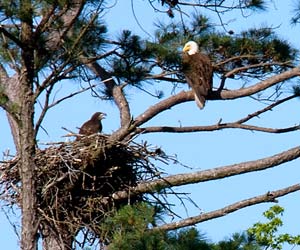
Nesting Behavior: Bald eagles mate for life and build their nests in tall trees near rivers, bays, and wetland areas. About 60% of the bald eagle nests in the Chesapeake Bay region are located in mature loblolly pine trees. Nests are made of sticks and contain grass, pine needles, and sometimes pieces of cornstalks. Eagles add to their nests each year, and after many years of successful nest building, their homes may grow to around 10 feet in diameter, 12 feet deep, with a weight of up to 2 tons. Unlike ospreys, bald eagles are easily disturbed by humans, so eagles often build nests in more isolated areas. These nests can be 80-110 feet above the ground.
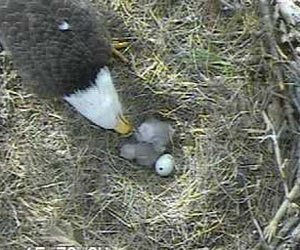
In the fall, adult bald eagles begin preparing their nests for the upcoming breeding season. Bald eagles on the lower Eastern Shore and in southern Maryland lay their eggs in late January, while eagles along the upper Chesapeake Bay and inland lay eggs in late February or early March. Incubation lasts from 32-36 days, and both parents take turns tending to the eggs. After hatching, the young stay in the nest about 12 weeks. In June, the young eagles—which look brownish black without a white head—are ready to leave the nest. Young eagles will stay with their parents throughout the summer and achieve complete independence in the fall. Although young eagles roam a great deal, they normally return to the same general area where they were born when they are old enough to raise their own families.
Threats: Bald eagles have few enemies, but at times humans certainly have been one of them. Like many birds of prey, bald eagles suffered during the 60s and 70s due to the rampant use of DDT and other dangerous pesticides. Research done at Maryland's Patuxent Research Refuge was used in Rachel Carson's classic book "Silent Spring," and alerted citizens, scientists, and politicians to the fact that DDT was harming bird populations. Patuxent's scientists discovered that DDT was working its way up the food chain and thinning the eggshells of raptors, which made the eggshells crack when the birds sat on them. Fortunately DDT was banned in the U.S. in 1972, and thanks to the Endangered Species Act (ESA), as well as the hard work of many dedicated people, birds of prey are beginning to rebound.
In 2007, the bald eagle was officially removed from protection under the Endangered Species Act because the population has recovered; however, bald eagles still have some legal protection under the Migratory Bird Treaty Act and the Bald Eagle Protection Act, although they will lose the habitat protection that was afforded them under the ESA.
Other Eagle Websites
- Bald Eagle: Information form the Chesapeake Bay Program about eagles.
- All About Birds - Bald Eagle
- EagleTrak
- Bald Eagle Nest Monitoring
Return to the Blackwater NWR Eagle Cam or the Cam Central page.